
The Grief Kit

I have been thinking about this post for several months. Here goes.
On November 9, 2022, a Wednesday, my 12-year-old German Shepherd passed away. That morning, as I was preparing for my online afternoon class, Sylvie started panting and acting as if she needed to go outside. It was warm in the cabin and time for our mid-morning walk. It was a sunny, bright fall day. As Sylvie got about 20 feet from the back door, she collapsed. Concerned, I sat down beside her on the ground. I checked her gums first; they were pale. Next, I felt her ears; they were cold; Next, I felt her paws; they were cold. I knew that she had the horrible hemangiosarcoma, a blood-organ destroying cancer that German Shepherds are prone to and also the same cancer that took her sister, Dakota, in the spring and my first GSD, Stella, in 2010. As I would learn in the next few hours, this was the case.
That fall, we were living in Phoenicia, NY. We did not have an established vet (that was in process) and we were “out of range” for any area mobile vets. So, with the help of a neighbor, we loaded Sylvie in the back of my Honda CR-V and I drove 1.5 hours to Albany to a 24-hour emergency vet. We arrived at Upstate Veterinary Specialties at around 2PM. They placed Sylvie on a gurney to get an ultrasound and emergency evaluation. I told the vet what I thought was going on. In 20 minutes, she came in the consultation room and told me that I was right. She explained, “You were correct, I am sorry to say. With hemangio, the cancerous tumors affect, most often, the spleen, liver, kidneys. In Sylvie’s case, however, it is her heart.” She continued, “Given that this is the situation, this is most likely why she showed no symptoms. She ate, drank, appeared normal. She may have slowed down a bit but you could not have known, you could have had no clue. This is cardiac hemangiosarcoma” The only option was to euthanize her. My dear readers, many of you know the rest of the story.
The writer pauses here…
This post, while it begins with the story of Sylvie’s death, is about what I call the “grief kit.” The grief kit is as much about the material objects that accompany the death of our loved one as it is a mode of narrating that loss. For Victorians, we can think about the memento mori and the practice of photographing the dead, creating jewelry or artworks from the hair of the deceased, or many other rituals of the time. One might think of it as a set of conventions that define how we experience death and also as a series of expectations about how one moves through grief. How do we expect others to tell their stories? Are there patterns? Just as I felt the need to begin this post with an account of Sylvie’s sudden illness and death, did you expect that I would start this way? If not, why not? If yes, then where did that expectation come from? We can surely regard social media as well as this Substack form as part of the “grief kit.” Facebook, for example, is a primary means of letting people know about deaths of friends, family, nonhuman companions, and others. Birthdays of the deceased are marked; posts are placed on their pages. These pages become places for those who remain to share their memories and feelings. The death news circulates through social media very quickly. And, it, along with Instagram and other social media channels, also becomes a site for mourning and grief. (This is the place in the text when I would cite several academic sources. However, I will save that for another writing context).
Two weeks later, I returned to the hospital to collect Sylvie’s ashes. The plan was not to cremate Sylvie; I had imagined a scenario in which we returned to my home in New Mexico and she would pass here in the mountains. When the time came, our local vet, Dr. Ted, would come to our house and put her to sleep. My friend Mollie and I would bury her in the back of my property next to a huge boulder that we used to sit on. Instead, I was handed a dark blue bag that contained her ashes (I despise the portmanteau “cremains”) and the “grief kit.” Here is a photo of the bag and its contents.
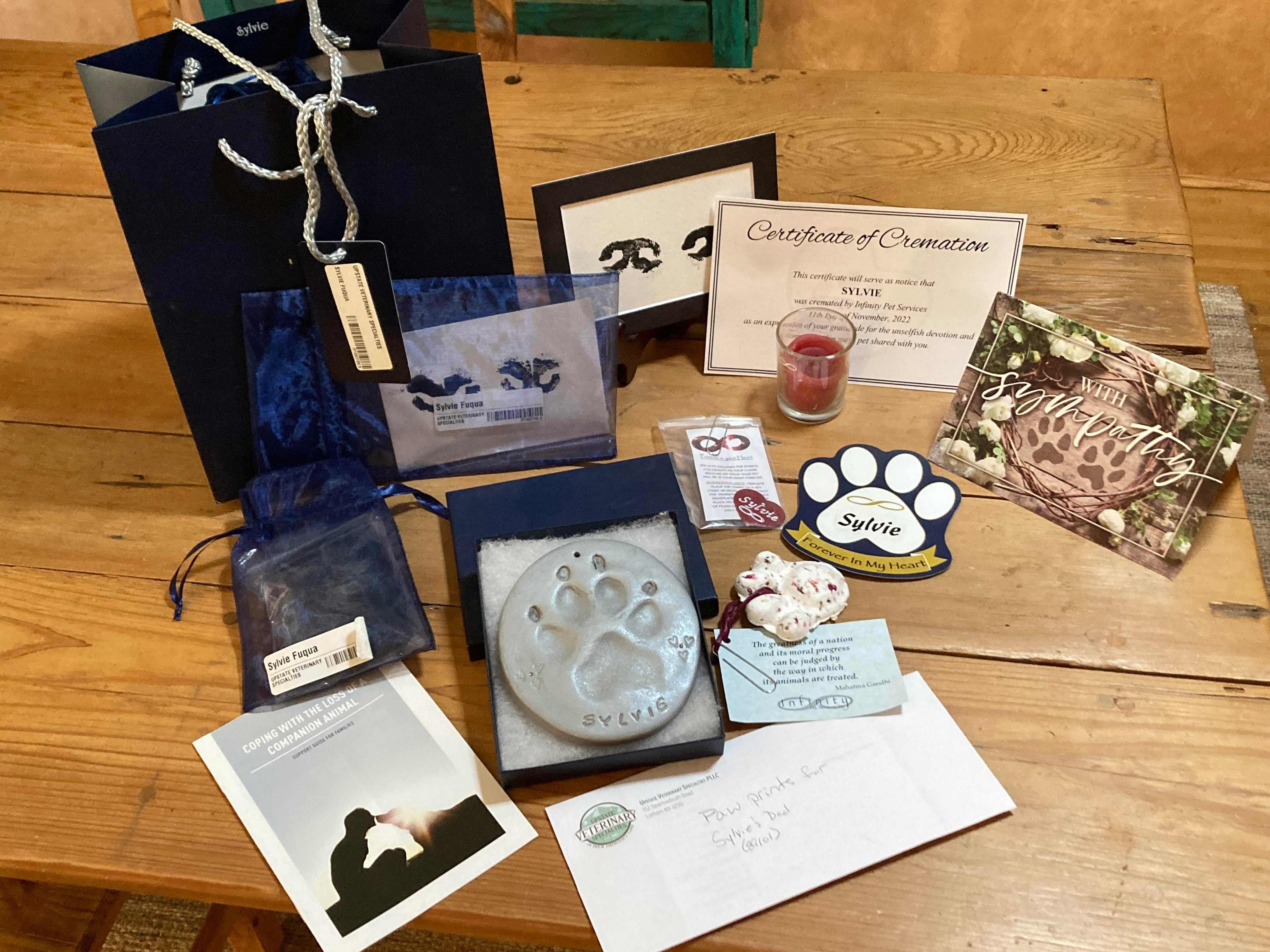
The blue bag included these things:
Sylvie’s ashes in a blue velvet bag (nicer than those Crown Royal whiskey bags)
one sheer, blue package containing some fur
several nose prints
several paw prints for “Sylvie’s Dad”
one paw impression
one candle with her name and an infinity symbol
one magnetic memorial sticker (for my car?)
one paw wildflower ornament
“Sylvie forever in my heart” tag
one easel to display the prints
one sympathy card from Dr. Weller
one certificate of cremation
one support guide “Coping with the Loss of a Companion Animal”
As these kinds of experiences go, this was a pretty classy and thoughtful way to package Sylvie’s death. I have to say, though, that when I unwrapped these items, especially the magnet, I was really aggravated. I felt a revulsion toward most all of these items; it felt as if our relationship and Sylvie’s death was somehow being commodified or rather “thingified.” I was reminded of those key chains with names and other assorted items you can buy at Love’s Travel Stop or Stuckey’s. If I had done this, made some of these items, or if a friend had made them, I am not sure I would have had the same response. And it seemed to me that these assembled items signaled a preferred way to grieve. Kind of a dominant mode (Stuart Hall) of moving through and expressing one’s grief. I kept thinking of what it was like for a staff member to go to Sylvie’s body and make these impressions. Images from HBO’s Six Feet Under kept coming to mind. Did the hospital have these other items printed or was this service included in the cremation fee?
Please don’t get me wrong. I am grateful for the consideration expressed by the hospital and its staff. I am grateful to have Sylvie’s ashes, her fur, her prints. The assembled objects prompt me to think about the ways grief is signaled, about how these objects are assumed to move us along this conveyor belt of loss. Are there guideposts to let us know where we are? Should there be? I doubt it.
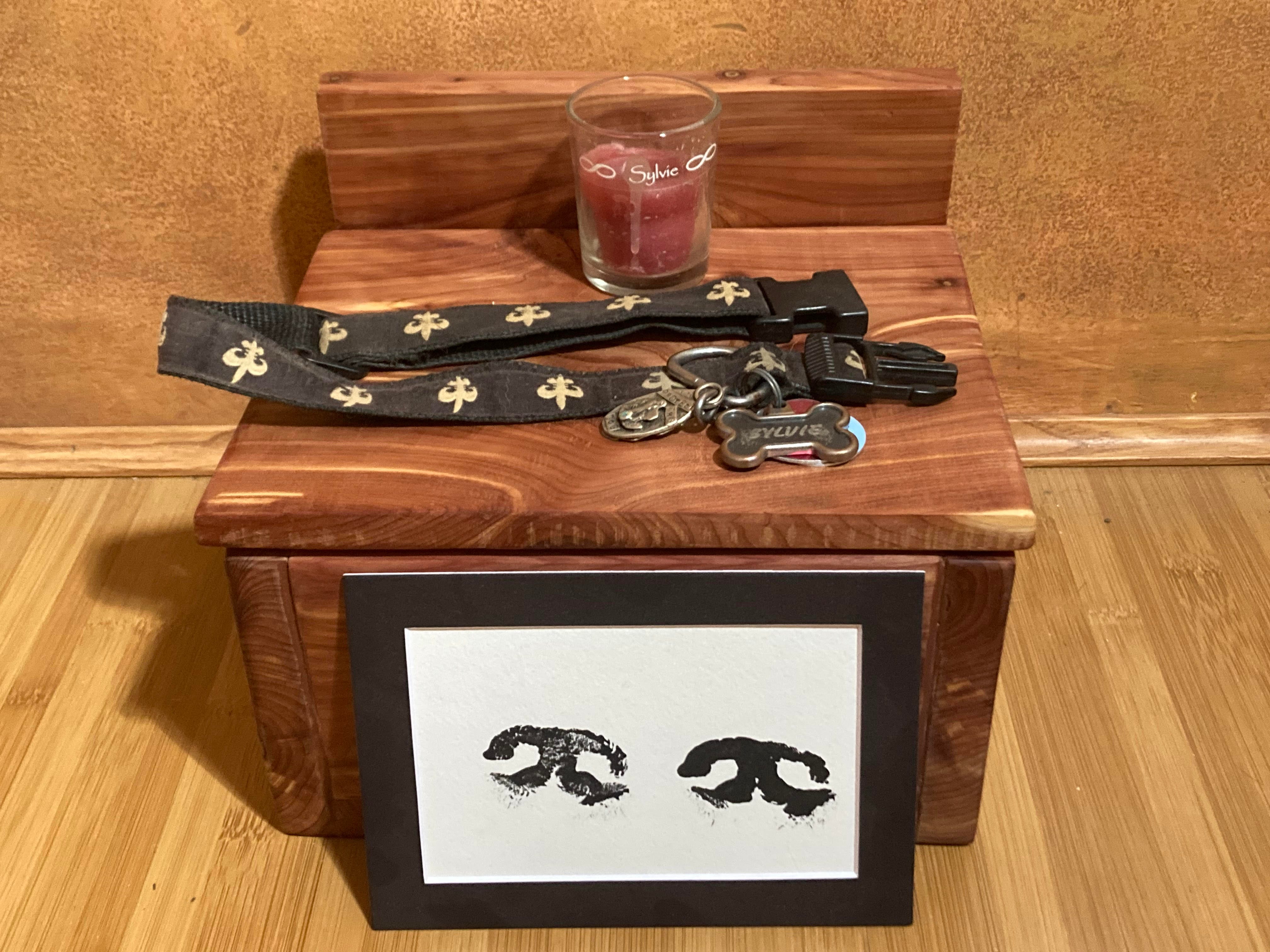
A few weeks ago, I asked my friend and carpenter, Andrew, to build a small box for Sylvie’s ashes. He built Sylvie a cedar box, from local wood, and rubbed it with linseed oil; the grain shimmers and the aroma fills the room.
-30-
Gorgeous post. I think it took me a minute to read this because I knew and loved Sylvie. She was so special she seemed immortal. I guess she is in a way you’ve captured here, talking about the resonance of these artifacts--maddening as they are. Really glad you’re writing about this, it’s a joy to read your insights.
I do love the prints, though. The sweet tech had trouble getting Butter Bean's because he was so very furry. He little (actually kind of big) nose print slays me. Thank you for sharing Sylvie and her thingified prints with us. We love you dearly.